MotoGP 2026 Title Race: The Complete Head-to-Head Breakdown
Twenty-four points. That's the entire gap covering five riders as the 2026 MotoGP season heads into its summer break — the tightest title race the sport has seen in years, and by some counts, a record for how many riders remain realistically in contention this deep into a season. Jorge Martín leads. Ai Ogura, Marc Márquez, Marco Bezzecchi, and Fabio Di Giannantonio are all within striking distance. And unlike most tight title races, this one isn't two riders slowly pulling clear of the pack — it's five riders who have each, at some point this season, looked like the clear favorite, and each been knocked back down.
Hamza Abrar
July 19, 2026
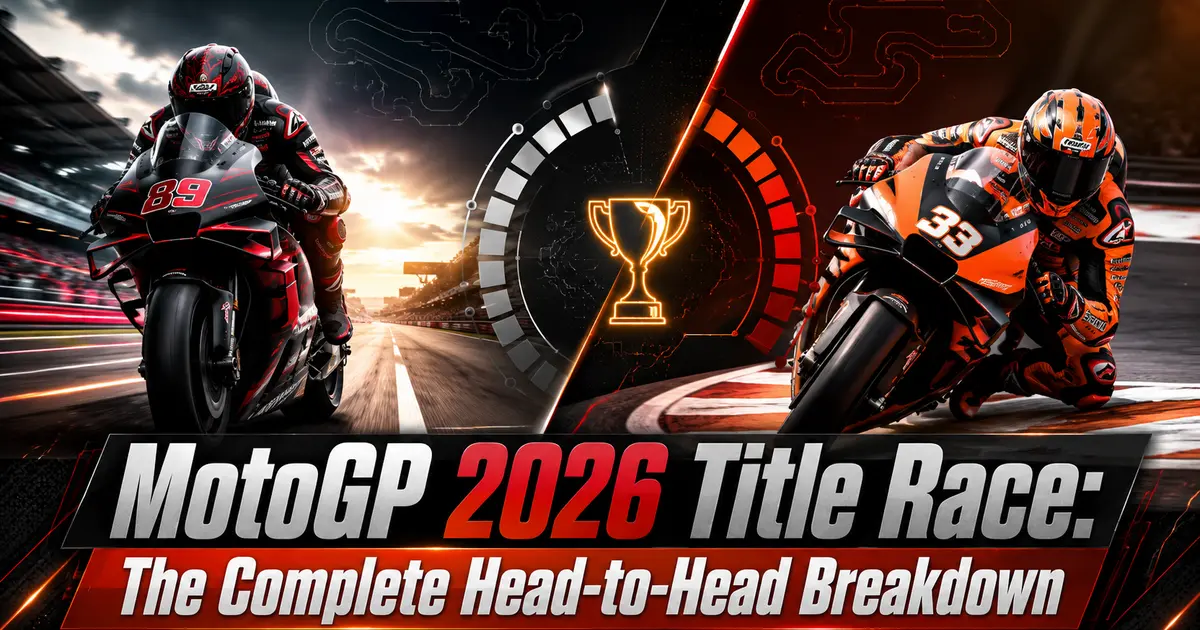
Here's exactly how they stack up, rider by rider, and what actually separates them beyond the points column.
The standings, 11 rounds in
| Position | Rider | Team | Points | Gap to leader |
|---|---|---|---|---|
| 1 | Jorge Martín | Aprilia Racing | 208 | — |
| 2 | Ai Ogura | Trackhouse (Aprilia) | 194 | -14 |
| 3 | Marc Márquez | Ducati Lenovo | 190 | -18 |
| 4 | Marco Bezzecchi | Aprilia Racing | 186 | -22 |
| 5 | Fabio Di Giannantonio | VR46 | 184 | -24 |
Márquez himself put it plainly when discussing the title picture recently: there aren't just two names in this fight, but five who could realistically become champion. That's not paddock diplomacy — the numbers back it up.
Jorge Martín: the leader who's about to lose his ride
Martín tops the standings, but his situation is stranger than a typical points leader's. He's already confirmed to be leaving Aprilia at the end of the season — Pecco Bagnaia is set to take his seat for 2027 — which means this is effectively his one shot at a title on this specific bike. That's usually the kind of pressure that sharpens a rider's second half of a season, though it cuts both ways: a rider with nothing left to lose can either relax into it or tighten up under it.
Martín's season hasn't been flawless. He had a rough weekend at Catalunya that left him with the most crashes of any of the five contenders this season — a genuine reliability question mark sitting underneath a season-long points lead. Leading the championship while also leading the crash count is an unusual combination, and it's the single biggest variable in whether he can actually close this out.
Ai Ogura: the rookie nobody saw coming
If there's a breakout story of the 2026 season, it's Ogura. He's a 2024 Moto2 champion who finished a modest 16th overall in his rookie MotoGP season last year — and this year, he's second in the championship, trailing the leader by just 14 points, in only his second premier-class season.
What makes his case genuinely remarkable isn't a single standout result — it's the absence of bad ones. Across every Grand Prix and Sprint this season, Ogura has failed to score points exactly once: a mechanical failure while running for a likely podium at round three in Austin. Everywhere else, he's scored. In a sport where a single DNF can hand 25 points straight to a rival, that kind of reliability is arguably as valuable as outright speed — and by the reliability numbers alone, it makes him the most dangerous rider left in this fight.
Marc Márquez: the 102-point comeback
Márquez's 2026 season is the strangest arc of any of the five. He started the year still recovering from a shoulder and nerve injury dating back to a crash the previous October — a loose screw lodged near his radial nerve that surgery hadn't fully resolved, quietly sapping his form through the opening rounds. At his low point, after the Italian Grand Prix at Mugello, he sat 102 points behind the championship leader and had all but written himself out of title contention for the year.
Since then: a dominant win at the Sachsenring — his tenth premier-class victory at that specific circuit, equaling Giacomo Agostini's all-time record for wins at a single track — plus a run of Sprint and Grand Prix results that has cut a 102-point deficit down to just 18. Whether that trajectory is a full recovery or a hot streak is the biggest open question of the second half of the season, but the direction of travel is hard to argue with.
Marco Bezzecchi: from runaway leader to sidelined
Bezzecchi's season is the inverse of Márquez's. He opened 2026 with four wins in his first seven races and six top-two finishes in that stretch — form good enough that after a Mugello victory, he led Martín, his own teammate, by 17 points, and looked like the standout favorite for the title.
Then it unraveled across three consecutive rounds: a suspension from the Czech Grand Prix for striking a marshal after a Sprint crash, a race-ending crash at the Dutch GP, and a fractured collarbone sustained in qualifying at the German GP that ruled him out of that race entirely. Zero points across all three weekends, on top of a crash count that — by one outlet's count of this season's tumbles — sits second-highest among the five contenders, behind only Martín. He now sits fourth, and the single biggest question for the second half of the season is simple: does a rider who was the fastest man on the grid in April come back from a broken collarbone at the same level in August?
Fabio Di Giannantonio: the quiet, consistent fifth
Di Giannantonio doesn't have a single defining storyline the way the other four do — no suspension, no comeback arc, no rookie breakthrough. What he has is a season with no zero-point Sunday finishes until relatively late in the run of races, which is exactly why he's still fifth and only 24 points off the lead despite not being the fastest rider in the conversation most weekends. In a title race this chaotic, being the rider who simply doesn't have a disaster weekend is its own kind of championship strategy.
The constructor battle sitting underneath the rider fight
The five-rider title chase isn't happening in isolation — it's playing out against an unusually tight constructors' fight too. Aprilia currently holds the edge, fielding four competitive machines: the factory RS-GPs of Martín and Bezzecchi, plus the two Trackhouse-run bikes of Ogura and teammate Raúl Fernández. Ducati, by contrast, is spreading its points across six machines — factory, VR46, Gresini, and Pramac entries combined — which gives it more raw scoring chances across a race weekend even without a single standout rider at the very top.
That structural difference matters for how you read the title race. Aprilia's four bikes are concentrated at the front of the standings (three of the top five overall are Aprilia riders), while Ducati's points are more spread out across a bigger stable. Whichever brand ends up winning the constructors' title, the story of how it got there will look completely different.
Sprint Saturday vs Grand Prix Sunday: where the points actually come from
Not every point in this title race is coming from the same kind of session, and the split matters. Only two riders in the entire field have managed to win both a Sprint and a full Grand Prix in the same weekend this season — Martín and Márquez — which is a genuinely rare double given how differently the two formats reward riders. Sprints favor a fast, low-risk opening burst over 100km or so; Grands Prix reward race-long tire management and consistency over roughly double the distance.
Márquez in particular has leaned on Saturday scoring as part of his comeback — by one point in his resurgence he'd already banked three or more Sunday wins and four Sprint wins on the season, a rare combination that shows his return to form wasn't limited to one format. For a title race this tight, the sprint-versus-Grand-Prix points split isn't a footnote; a rider who's strong on Saturday but inconsistent on Sunday (or vice versa) is a fundamentally different title threat than one who's equally dangerous in both.
How rare is a five-way title fight, really?
Framing this as "the tightest in years" is one thing to say; it's another to actually check it. MotoGP has had close title fights before — the Rossi–Lorenzo era in the late 2000s is the most commonly cited comparison for how closely this season is being watched — but a genuine five-rider spread this deep into a season, with the lead changing hands multiple times before the summer break, is unusual even by the sport's own history.
That's a claim worth checking against the record rather than taking on faith. MotoSector's History archive covers every season back to 1949 with full standings and season records for each one — so if you want to see exactly how the points gaps in, say, 2006, 2015, or 2020 compared to this season's 24-point, five-rider spread, the data to check it yourself is one click away rather than something to take a single article's word for.
The 2027 shadow hanging over every decision
There's a layer of pressure on this title race that goes beyond the points table: 2027 brings MotoGP's biggest technical overhaul in over a decade — smaller 850cc engines, a new tyre supplier, and trimmed-back aerodynamics — and several riders in this exact fight are riding for teams or seats that won't exist in their current form once those rules land. Martín already knows he won't be on this Aprilia next season. A volatile rider market building around the regulation change means 2026 isn't just a title fight — for at least some of these five, it's the last chance to win a championship on a bike they know intimately, before the entire grid effectively resets.
The real differentiator: who actually finishes races
Line the five up by how often they've actually failed to score, and a clear pattern emerges. By one detailed count of this season's crashes: Martín has come off his bike 16 times, Bezzecchi 12, Márquez 11, Di Giannantonio 10, and Ogura just 5 — by a wide margin, the most reliable rider of the five. (That specific tally comes from a single outlet's season-long count rather than official multi-source data, so treat it as a strong directional signal rather than a certified statistic.)
That gap matters more than it might look on paper. In a field this tightly bunched on points, consistency and DNF risk aren't a secondary stat sitting behind pace and results — for four of these five riders, an off weekend has already cost them the championship lead at some point this season. It's exactly the kind of factor that a single "who's fastest" ranking misses entirely, and exactly why a serious prediction model treats consistency and risk as its own separate signal rather than folding it into raw speed.
What each rider needs from the second half
- Martín needs to stop crashing more than he needs to go faster — he already has the points lead
- Ogura needs to keep doing exactly what he's doing; the case against him is that nobody knows yet whether a rookie's consistency holds up under second-half title pressure
- Márquez needs his current form to be a genuine return to fitness, not a hot streak that fades
- Bezzecchi needs a clean return from injury and, just as importantly, a clean run without further off-track incidents
- Di Giannantonio needs one or two standout results to convert quiet consistency into genuine title pressure
How to actually track this yourself
Reading five separate narratives is one way to follow a title race. Comparing the actual numbers side by side is another. MotoSector's Stats page has a Compare tool built for exactly this — pick any 2 to 6 riders and get a direct metric comparison, position and cumulative points charts, and a head-to-head "races ahead" tally, rather than relying on any single article's framing (this one included).
If you want to see how the model's Consistency & Risk signal is actually scoring each of these five right now, that's on the Predictions page — the same signal category that explains exactly why Ogura's reliability matters as much as anyone's outright speed in a title race this close. And for the live sector-by-sector picture when Silverstone gets underway, Live Tracking has the full 3D view and timing tower, free.
FAQ
Who is leading the 2026 MotoGP championship? Jorge Martín leads with 208 points after 11 of 22 rounds, ahead of Ai Ogura (194), Marc Márquez (190), Marco Bezzecchi (186), and Fabio Di Giannantonio (184).
How many riders are actually still in title contention in 2026? Five — just 24 points separate the top five riders entering the summer break, an unusually large and tightly bunched group for this stage of a season.
Who has the best reliability record in the 2026 title fight? By one season-long count, Ai Ogura has crashed only 5 times, far fewer than Jorge Martín (16), Marco Bezzecchi (12), Marc Márquez (11), or Fabio Di Giannantonio (10).
How did Marc Márquez get back into title contention? He was 102 points behind the championship leader after the Italian Grand Prix at Mugello, recovering from a lingering shoulder and nerve injury. A strong run including a dominant win at the Sachsenring cut that deficit to just 18 points.
What happened to Marco Bezzecchi's championship lead? Across three consecutive rounds he was suspended for striking a marshal, crashed out of a race, and fractured his collarbone in qualifying — turning a 17-point lead into a fourth-place deficit.
Is Ai Ogura a realistic title contender as a second-year rider? Yes — he sits second in the standings, only 14 points off the lead, with the most consistent scoring record of any of the five contenders this season.
Which constructor is leading the 2026 MotoGP championship? Aprilia currently holds the edge with four competitive machines concentrated near the top of the standings, while Ducati is spreading its points across six entries — factory, VR46, Gresini, and Pramac combined.
Who has won both a Sprint and a Grand Prix in the same 2026 weekend? Only Jorge Martín and Marc Márquez have managed that double this season, reflecting how differently the Saturday Sprint and Sunday Grand Prix formats reward riders.
Compare any riders in the title fight yourself with the Stats Compare tool, or check live win probabilities on Predictions — both free on MotoSector.
Have Questions About MotoSector?
We're here to help.just answers to your timing questions.
Symilars
Ready to build something that lasts?
We turn business goals into high-performance software. No fluff — just execution.
Get a Free ConsultationRelated Articles
Who Is Raúl Fernández? The Story Behind Silverstone's Winner
e broke Marc Marquez's Moto2 rookie record. Then MotoGP nearly broke him. Here's the real story of Raúl Fernández — and why Silverstone was different.
11 min readCalendario MotoGP 2026: Próxima Carrera, Fechas y Horarios
Calendario completo MotoGP 2026 con todas las carreras, fechas y circuitos. Próxima carrera, clasificación actualizada y horarios de cada Gran Premio.
11 min readMotoGP 2026 Calendar: All 22 Rounds, Dates & Countries
The complete MotoGP 2026 calendar — all 22 Grands Prix, every country, every circuit, every date. Rounds 1-22 listed with standings and upcoming races.
11 min read